
Should I Buy an Electronic Pipette for My Laboratory?
Whether an electronic pipette makes sense for your laboratory depends on your workflow demands, assay sensitivity, and throughput requirements. While the operational needs of smaller laboratories with lower throughputs may be met by manual pipettes, electronic micropipettes are an advantageous investment for labs looking to increase standardization, employ advanced pipette modes, or reduce the repetitive strain of manual pipettes.
Few laboratory tasks influence experimental consistency as much as pipetting. Even small variations in liquid handling can affect downstream workflows and data quality. Laboratories pursuing greater reproducibility and higher throughput are turning to electronic micropipettes to streamline repetitive pipetting tasks and improve precision. But do they genuinely improve liquid handling, or are they simply a more convenient alternative to manual pipettes?
What Is an Electronic Micropipette?
An electronic micropipette uses a microprocessor-controlled stepper motor to regulate piston movement. Unlike a manual pipette, which depends on thumb pressure and a spring-and-piston mechanism, the electronic system performs liquid transfers according to programmed parameters.
Through a digital interface, researchers can control:
- Aspiration and dispensing speeds
- Standardized piston displacement depths
- Specialized operating modes for different sample types.
Common functions of electronic micropipettes include reverse pipetting for viscous liquids, automated mixing routines, and repetitive dispensing protocols. By controlling each step electronically, an electronic micropipette reduces operator-dependent variation and promotes more consistent liquid handling across experiments.
The Core Benefits of Electronic Micropipettes
Elimination of Operator Fatigue and Repetitive Strain
Throughout a busy laboratory day, researchers may perform hundreds of pipetting actions. Repeated plunger operation can contribute to hand and wrist fatigue, which may affect posture and technique over time. An electronic micropipette replaces manual force with an electronic trigger and motor-driven piston movement. Because aspiration and dispensing remain consistent regardless of user fatigue, volumetric performance can remain stable across extended workflows. For laboratories seeking greater standardization, improved ergonomics can support more reproducible results.
Optimization of Volumetric Accuracy and Coefficient of Variation
Fluid handling consistency is critical for assay performance. Manual aspiration speeds often vary between users, increasing the risk of air bubbles, liquid retention, or incomplete sample recovery. Such challenges become more apparent when handling viscous solutions, including glycerol-stabilized enzymes and concentrated protein preparations. An electronic micropipette maintains constant aspiration rates and standardized blow-out cycles regardless of the operator. The result is improved sample recovery, reduced volume drift, and lower intra-assay variation. With workflows such as quantitative polymerase chain reaction (qPCR) setup or next-generation sequencing (NGS) library preparation, greater consistency can improve confidence in experimental data.
Workflow Efficiency Through Advanced Operational Modes
Modern electronic pipettes introduce workflow enhancements that extend beyond simple liquid transfer.
Multi-Dispense Mode
Consider a researcher preparing a 96-well qPCR plate with identical reaction components. Using a manual pipette requires repeated aspiration from the source reservoir before each dispensing step. Multi-dispense mode changes that process. A single aspiration collects a larger volume that is subsequently divided into multiple precise aliquots.
This can lead to:
- Faster plate setup
- Reduced handling time
- Fewer entries into the source reagent reservoir
- Lower risk of cross-contamination
- Reduced surface tension effects during repeated aspiration cycles
Automated Mixing Sequences
Many molecular biology protocols demand thorough and consistent mixing. Magnetic bead suspensions used during nucleic acid purification provide a common example. Insufficient mixing can cause uneven bead distribution, while aggressive manual mixing may damage sensitive samples. Automated mixing programs perform pre-defined aspiration and dispensing cycles at controlled speeds. Consequently, every sample receives the same mixing treatment, helping researchers achieve more reproducible preparation conditions.
Custom Protocols
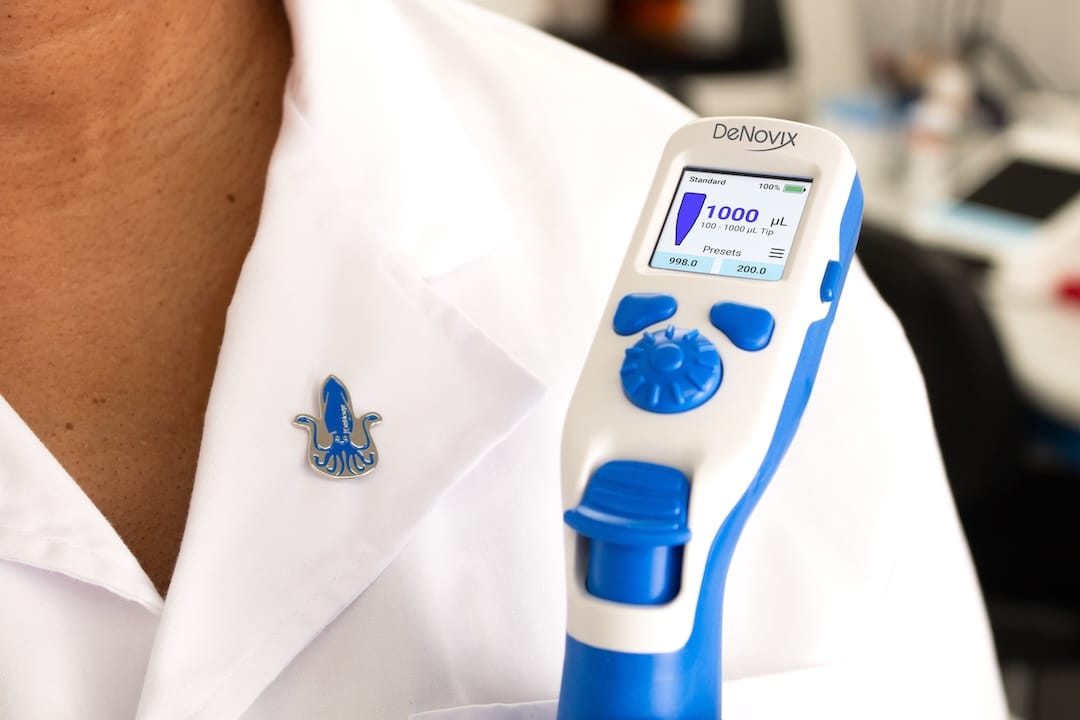
Some electronic pipettes, such as the DeNovix Squid™ Full Range Pipette (1 – 1000 µL), also include the ability to build custom protocols. This flexibility allows researchers to incorporate multiple operational modes into one sequence, further automating pipetting workflows. Using Squid, custom protocols can be built either on the device or on the Squid Desktop Software. Protocols can be deployed to multiple pipettes via Bluetooth®, which makes it easy to standardize lab work by ensuring that every researcher is using the same protocols.
Does Your Lab Actually Need An Electronic Micropipette?
Although the advantages are clear, not every laboratory requires an electronic micropipette. The decision should be guided by workflow demands, assay sensitivity, and throughput requirements.
Electronic integration may be worth considering if:
- Your laboratory performs low-volume qPCR, digital polymerase chain reaction (dPCR), NGS library preparation, or high-sensitivity enzyme-linked immunosorbent assay (ELISA) assays where volume deviations can affect outcomes.
- Researchers regularly process 96-well or 384-well microplates.
- Multiple technicians perform the same protocols and inter-operator variability has become a concern.
- Workflows frequently involve viscous reagents, enzyme stocks, or protein-rich solutions.
- Reducing repetitive strain is an organizational priority.
Smaller laboratories with lower throughput demands may find that calibrated manual pipettes continue to meet operational requirements. For facilities focused on quantitative molecular biology applications, however, the consistency offered by an electronic micropipette often provides measurable value.
The DeNovix Approach to Lab Precision
Reliable analytical results begin with accurate sample preparation, and every dilution and reagent addition influences downstream data quality. To support precision liquid handling, DeNovix developed the Squid™ electronic micropipette.
Covering a full volume range from 1 to 1000 µL, Squid consolidates the functionality of a traditional four-pipette set into a single instrument. A simple click toggles between Small Tip (1 – 200 µL) and Large Tip (100 – 1000 µL) modes, delivering sub-microliter motor precision while simplifying workflow management.
Building More Reliable Laboratory Workflows
Electronic micropipettes can enable laboratories to improve consistency, reduce manual variability, and simplify demanding workflows. Researchers looking to strengthen every stage of sample preparation and analysis can depend on DeNovix’s integrated portfolio of precision tools, including the Squid electronic micropipette and DS-11 Series Spectrophotometers and Fluorometers, to establish reliable, reproducible scientific research.
Reach out to DeNovix now to discuss our products in more detail and find the best liquid handling solution for your laboratory.

The Bluetooth® word mark and logos are registered trademarks owned by Bluetooth SIG, Inc. and any use of such marks by DeNovix is under license.