
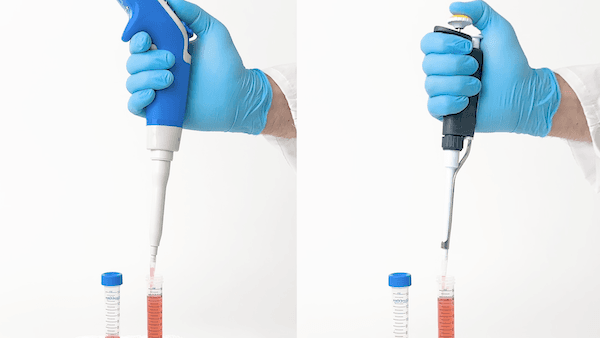
What is the Advantage of Digital Pipettes / Electronic Pipettes Compared to Manual Pipettes?
Using digital pipettes increases reproducibility, improves efficiency, and reduces operator variability compared to manual pipettes. Researchers with lower-throughput experiments may not require an upgrade, but digital pipettes / electronic pipettes are a practical investment for laboratories who value ergonomics, multi-mode functionality, and standardized results between users.
Laboratory workflows rarely stand still. Techniques evolve, throughput increases, and expectations for reproducibility continue to rise. Equipment that once met every requirement is continually being reassessed, including one of the most familiar tools on the bench: the pipette. For many laboratories, the decision of what type of pipette to use now centers on whether digital technology offers enough value to replace manual systems.
Manual Pipettes
At their core, manual pipettes depend on a mechanical air-displacement system. When the user depresses the plunger, an internal piston displaces a specific volume of air. Releasing the plunger generates a vacuum that aspirates liquid into the tip, while a mechanical adjustment dial controls the selected volume.
Manual pipettes are valuable because they are well suited for:
- Low-throughput laboratory workflows
- Quick single-reagent additions
- Experiments demanding frequent volume adjustments
- Situations requiring immediate operation without charging or power infrastructure.
Their simplicity and accessibility have made them a staple across research, diagnostics, and teaching laboratories.
Several limitations of manual pipettes become more apparent during repetitive or highly sensitive procedures:
- Manually controlled plunger movement can vary between operators, resulting in differences in aspiration and dispensing speed
- Prolonged hand contact may warm the internal air column and contribute to volumetric drift
- Repetitive plunger movements can increase the risk of hand fatigue and repetitive strain injuries.
As throughput increases and assays become more sensitive, these sources of variability can have a greater impact on experimental consistency and data quality.
Digital Pipettes
Unlike manual systems, a digital pipette replaces mechanical piston movement with electronically controlled motion. An internal microprocessor directs a stepper motor that moves the piston with highly controlled speed and distance. Instead of relying on manual adjustments, users enter the desired volume through a digital interface.
A significant advantage of a digital pipette is the reduction of operator bias. Automated aspiration and dispensing speeds help maintain consistency regardless of who performs the procedure, improving reproducibility across teams and experiments.
Electronic control also enables liquid handling functions that are difficult to perform manually. Common examples include:
- Multi-dispensing from a single aspiration cycle
- Automated serial dilution workflows
- Reverse pipetting for viscous liquids
- Controlled dispensing for volatile reagents
Such capabilities can streamline workflows ranging from qPCR plate preparation to compound screening and standard curve generation.
Ergonomic improvements provide another benefit. Most digital pipettes require only a light button press to perform liquid handling tasks, reducing physical strain during high-volume sample preparation.
Historically, however, laboratories often needed multiple digital pipette units to cover standard volume ranges. Purchasing separate instruments for low-, medium-, and high-volume applications increases acquisition costs while adding calibration and maintenance responsibilities.
Is the Upgrade Worth It?
Whether upgrading to a digital pipette makes sense depends largely on workflow requirements. Laboratories performing occasional liquid transfers or low-throughput experiments may find that manual pipettes continue to meet their needs effectively.
The equation changes if protocols demand high reproducibility, repetitive dispensing, or extensive plate-based workflows. In these situations, a digital pipette can reduce operator variability, improve consistency between users, and minimize physical strain during prolonged use.
Cost has traditionally been the primary barrier to digital pipette adoption. Platforms that consolidate multiple volume ranges into a single instrument change that calculation significantly. When users can replace several electronic pipettes with just one device, the operational benefits of automation become far easier to justify.
Overcoming Volumetric Limitations: The DeNovix Squid™ Pipette Architecture
With many laboratories, the need to maintain multiple electronic pipettes has represented the primary obstacle to adopting a fully digital workflow. DeNovix designed the Squid™ Full Range Pipette (1 – 1000 µL) specifically to address this challenge.
At the center of the Squid system is Dynamic Volume Control™ technology, which combines a proprietary internal tip-selection mechanism with an ultra-precise, micro-stepper motor platform. Rather than operating within a fixed volume range, the instrument automatically adapts its internal parameters based on the active Tip Mode.
Through its dual-tip architecture, Squid allows researchers to use either 200 µL or 1000 µL tips. As a result, a single instrument can support two distinct operating profiles:
- Lower-volume liquid handling from 1 – 200 µL
- Higher-volume liquid handling from 100 – 1000 µL.
With the Squid Pipette, researchers can move between preparing PCR master mixes, dispensing sequencing reagents, and handling larger buffer volumes without switching devices.
The practical impact extends beyond convenience. Switching from several electronic pipettes to just one device reduces calibration management, simplifies inventory control, and frees valuable bench space. Laboratories can standardize liquid handling procedures across a broader range of applications while maintaining a single electronic platform.
Performance remains equally important. By delivering high levels of accuracy and precision throughout its operating spectrum, Squid consistently exceeds ISO 8655 requirements. Such a capability allows users to eliminate multiple dedicated pipettes and avoid compromising data quality or experimental confidence.
Simplifying Liquid Handling with DeNovix
The decision to update to a digital pipette is ultimately about supporting better science. When workflows require enhanced reproducibility, reduced hands-on effort, and fewer opportunities for operator variability, electronic pipetting becomes a practical investment.
With the Squid Full Range Pipette, DeNovix has reimagined what a single device can achieve, combining Dynamic Volume Control™ and dual-tip interfacing to support accurate liquid handling across a 1 – 1000 µL range.
Speak with our specialists now to discover more information about Squid and our broader portfolio.
Ready to Join the #SquidSquad?
Your Squid Pipette is waiting for you. Buy now or request a quote to start simplifying your workflow.